“V” is for Validate

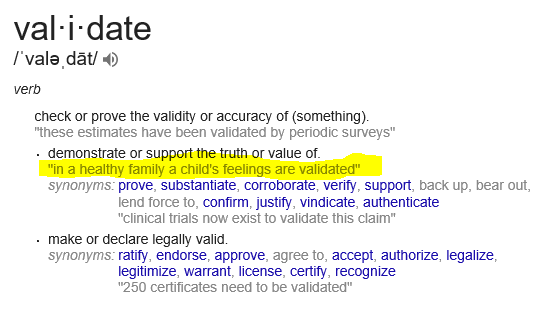
In order to begin to write this post, I “Googled” the word:ValidateIf Google gives an example using healthy families, I must be onto something.

Approval, Female, Gesture, Hand, Happy, Isolated

I started to use validation as key to getting along with my very opinionated three year old son, and it’s made him so much happier.  Me, too!  Here’s just one example: vending machines at the YMCA.  Kids like to slide quarters into those machines like my 91 year old aunt in Atlantic City.  Almost every time I take him to the gym, I’ll get a, “I want-” with his current obsession- pretzels, animal crackers, chocolate wafers…

Instead of me saying, “No,” which logically would set him up to reply, “But, I WANT it,” I say, “Wow!  They do look really tasty.  I can see why you like them.  I’d like some, too.  Right now, I don’t have any quarters.  But we do have them at home.  How about I give you a snack of pretzels after we leave here… in about five minutes.  Can you be a good boy and be patient to wait until then?”  He always agrees to be a good boy.  I make good on my promise.  He now trusts me to validate his feelings… and they have never escalated since validating him.

It’s really an amazing shift to observe.

It’s tied in very closely to the “L” of Love, “Listen.”

Kids — and people in general — just want to know that they are being heard and valued.  That’s it.  It’s why wives resent it when their husbands try to fix their problems, when all they wanted was a sympathetic ear.  It’s why tweens resort to whining.  It’s why customer service stinks half the time.  We just want to be validated that we have a right to our feelings.

Make the #153Promise to validate your children’s feelings.  Let them know that even if you’re not willing to buy that outfit at the mall, you understand why they want it.  And then work together to find an acceptable alternative to both sides, rather than just saying, “No… because I SAY so!”  The last thing you want to do is shut them down.  They’ll only resort to either being sneaky or going to someone else instead who “Gets” them.

Try it this weekend.  Make the #153Promise to validate each one of your children at least once when you catch yourself wanting to say “No” and watch what happens.

Then validate ME by coming back and posting a comment about how it went!

-Kisses! XxXx


“O” is for Observe

Quick Quiz:

What is the U.S. of A.’s national symbol?

Can you imagine if “B” were the symbol of the U.S. Military? There’s a reason one of the world’s Super Powers’ wants to be associated with keen eye sight.  It keeps us protected.

Observation is a powerful tool.

Eyes, See, Point Of View, Window, Sensation, CharmAs a teacher, I have to report students’ observable behavior to case managers and guidance counselors all the time.  It’s called “Progress Monitoring.”

Santa sees children when they are both sleeping and awake.

We, as a society, are under surveillance everywhere we go.  Kind of creepy, until you become a victim of a crime and law enforcement can pull up video to catch a suspect.

How observant are you regarding your own children?Ostrich, Eyes, Animals, Portrait, Observe, Green, Head

  • Can you tell when he or she is sick, tired, or had a bad day at school?
  • When was the last time you went through their backpack?
  • Their room or the things in it?
  • Their cell phone?
  • How about any prescription drugs in the house?

I’ll admit, there seems to be a fine line between observing and spying.  But your children are under your charge.  They are minors living under your roof and you do NOT need a warrant in order to seize and search the items you pay for.

I think there’s a right and a wrong way to do it, though.

I was under strict surveillance growing up.  I think it was too much.  I had no voice at home (more on that later) and everything I did was criticized.  I wasn’t a bad kid; my dad was paranoid.  As a result, ironically, it backfired and I did and hid things just to have some part of my life that wasn’t under their thumb.

My father’s observation was unwarranted (figuratively!) so it was a major source of stress in my life.  He also was sneaky about it and didn’t just keep a watchful parental eye over my life- he snooped.  So did my mother.  As a result, I felt very violated.  And I did the only thing I could think of: I rebelled… but I had to in a very passive aggressive way, or I’d get in BIG trouble.  That’s not the tactic to take when observing.

Rather, you set up the parameters and boundaries AHEAD of time.  You articulate consequences BEFORE infractions.  And you let them know that if you ever suspect something concerning, you will TELL them what you OBSERVED and then request to observe more data to either dispel or confirm your fears that they may be doing something that is putting them in harm’s way.  And, of course, you say it in a kind — rather than threatening — tone.

It’s called transparency.

If you children think that you can see right through them, your conscience will guide them when you are not physically around.

How are they behaving in school?  Who are their friends and what are they texting?  Are they are where they say they are?  Do they eat their lunch you pack?

Make it your #153Promise to be an eagle; not an ostrich.

-Kisses!  XxXx

*I did the research, and technically, their heads are in sand a lot to check on their eggs… which are buried in the sand.  So you still get a gold star for the day.  I was focusing on the popularly accepted metaphor.  (Just in case some ornithologist is reading my post!)


“L” is for Listen…

I made a post a while back on my acronym for LOVE.  It’s such an important concept that I thought each letter deserves its own day.

Mila Repa, Buddha, Bodhisattva, Esoteric, Right Hand“Listen” is the first word that spells out how to love (according to me).  If you don’t listen to someone, communication and trust breaks down, and it’s pretty difficult (if not impossible) for them to believe anything you say to them.

My daughter gave me the perfect example last night.

We were all eating dinner last night- my husband, our ten year old daughter, our three year old son, and me.  My daughter is from a two-household situation, so she’s with us Mondays, Tuesdays and every other weekend.  It stinks, but we manage.  Of the time she’s with us, Mondays and Fridays are gymnastics, and my husband works on Fridays and Saturdays.  Therefore, Tuesday nights are the only time we can have an extended dinner together.  Again, it stinks, but we make the most of the time, being thankful that we make that part of the week a priority.

Picture the table: I’m talkative and love to reflect on my day.  Our son is a ball of white lighting and can easily dominate.  My husband, when he speaks, usually says something of deep import.  And then there’s our daughter.

She’s does have her chatty moments, but in general, she’s a monosyllabic girl.  When I ask her how her day went, “Fine” is usually what I get.  Such was the case last night.  But a few minutes later, in between second helpings of rice and chili, and our son’s random musings, I managed to hear “I cried in school today…

She then proceeded to unravel a convoluted thread of fifth grade drama involving a group project, conflicting ideas, allegations of copying, and bruised egos.  It clearly was important to her.  I listened to her and gave her my full attention.  I asked her if she’s okay now (she said she was) and she said, “I guess it’s just been an emotional week for me, with…” and then she emoted even more.  About being from a divorce situation; her great grandmother dying this week; course selection for middle school… I offered to contact her teacher on her behalf and reassured her that we’re there for her.

Imagine if, when she first said about her crying, I hadn’t listened to her.  What if I had just said, “Okay, Honey” and went on with my business?  It would have destroyed her.  Or what if we never made time to talk as a family?

Silhouette, Father And Son, Sundown, Chat, Advice

Make the #153Promise to connect with your children on a daily basis to ask them about their day and really listen.  It doesn’t have to be at a sit-down dinner; you can set the stage for “ear time” by:

  • having a “no electronics” rule in the car and use the taxi time to debrief each other about important issues
  • still “tuck them in at night” so they can have some one-on-one time with you
  • making breakfast a “sharing time” as everyone is getting ready in the morning (if lunches and backpacks are already packed, clothes are picked out the night before, and healthy breakfasts are available, it frees up a lot of important time)

Listening is the first step to let your children know they are loved.

-Kisses!  XxXx

Thanks, Grammy

Heart, Love, Discussion, Difference, RelationshipMy relationship with my mother is strained.  Suffice it to say we navigate life with very different operating systems that clash every time they interface.

My grandparents and I, (her parents), have never clashed.

“You don’t know them like I do,” she says.  A lot.

True- I don’t.  The dynamics of Grammy and Grandpop and me are different; they didn’t raise me.  They are people I visited every Sunday after church.  Then, once I got older, I would choose to see them independent of my parents.

I could write a whole book about this narrative, but the reason I even mention them is that at 89, it looks like my grandmother will not be around much longer.  Around October, doctors found something on a chest X-ray they didn’t like, but she refused diagnostic tests.  They told me that their best guess was that she had about six months to live.  She was put on hospice and this week, she started falling and she’s been bed-ridden and on morphine.

I took off a day from school on Thursday to essentially say goodbye and give my input on funeral arrangements.  (I said I’d like to put together a PowerPoint to loop during the viewing and I’ll compose a poem to be put in the funeral program.)

Because I have peace with Grammy, I’m able to deal with this dying ordeal pretty well, I think.  But my mother?  It’s taking everything in me to stay patient and kind as she manages to grapple with the reality that the woman she’s been complaining about all these years is leaving.

I’ve come to realize that validating someone’s opinion is essential to any relationship.  That doesn’t mean you have to agree with them; you only need to let them know that you understand their feelings.  Understand (v)- to perceive the intended meaning.  So when I understand that my mother thinks a certain way — and I allow her to have that opinion — then I have attempted to validate her feelings.  I try to be very clear that I while I understand how she feels about Grammy and Grandpop, that is not my truth… and I’d really appreciate if she’d allow me to have mine.

I’ve been suggesting to my mother that she make her own peace with her parents now so she can have peace once they are gone.  I know she’s done a lot for them out of duty, obligation and guilt so she can have a “free conscience” regarding their care.  That may be nice so she has no regrets regarding what SHE has done or failed to do.  However that doesn’t mean she has resolved the issues she has with what she thinks they have done to her.

I’ve told her that I just want her to be happy.  “Well, maybe I think I don’t deserve to be happy,” is her response.

Street Sign, Note, Direction, Point Of View, Sensation

There it is.  I can’t compete with that mentality.  So I take a step back and concern myself with my own happiness and fostering happiness in my own children.

Granted, you can’t “make” someone happy- but you can treat them in a way so they learn that you think they are deserving of happiness.  And you can model positive behaviors that foster self-care results in your own happiness.

Grandparent are synonymous with giving, and the most recent gift my grandmother gave me from her deathbed was the lesson in validation and gracefully understanding opinions that are different from my own.*

Bald Eagle, Soaring, Bird, Raptor, Flight, Nature, BaldIn the spirit of my grandmother living a full life, I’m going to pass along that lesson in this post, so it my live on after I get the word that Grammy is gone from this Earth.

Make it your 153Promise today to: model the ability to make yourself happy; validate others by showing them you understand their opinion, even if yours is different…  It avoids conflict and can sustain peace…  Make the 153Promise by telling people close to you that you want their happiness, too, and foster an atmosphere where they feel free to pursue their happiness.


*(The irony is that my father — her son-in-law — and my grandparents would clash all the time… What’s in common?  My mother… again- another book!)


Social Media is “S & M”

woman-929838_1920Twitter; Instagram; Snapchat; Facebook…  these are the new ways to forge relationships, “Like” it, or not.

I find people’s behaviors on social media very interesting.  It’s like of like being drunk: it’s an altered state.  People post things to their “Friends” and make comments they would NEVER do in “real” life.  It begs the question- do people’s real hidden sides come out on the internet, or is there something essentially nefarious about screen interactions?

I’ve seen people who are normally very decorous give raunchy memes the “thumbs up.”  Closeted bigots post anti-fill-in-the-blank comments.  People go on rants about other people and things get shared, amplified and eventually feelings get hurt and real-life friends or relatives get blocked or “un-friended.”

It’s no coincidence to me that social media has “S” and “M” as its initials.  There’s a certain sadistic pleasure some people get from updating a status that will irk others.  And I can’t tell you how many times I read or hear about people’s feelings getting hurt because they were excluded from whatever online group membership they belong… yet they continue to engage in the drama, as if they get some sort or masochistic rush.

In that sense, I don’t see adults being any more mature than their teenage counterparts.

Kids learn what they see.  What kinds of real messages about relationships are you sending by the ones you post online?

Make it the #153Promise to model Sensitivity and Moderation with your social media.

Out of the Mouth of Babes: Inheriting Opinions from the “Media” of Parenting

I’ve been on a roll regarding the topic of what’s passed down from parent to child, and this post is no different.  I think it’s because I’m fascinated about how children develop and the role we as parents play in that process.

I’ve been a teacher, director and coach for over a decade and a half, so I’ve had  interactions with thousands of kids ranged from 11 to 18.  It’s amazing to me what kids:

  • don’t know (I can teach that.)
  • actually know (I can test that.)
  • think they know (I can challenge that… or can I?)

It’s the third category I’m going to discuss in this post.

Hand, Puppet, Snowman, Political

When kids know or don’t know facts, it’s my job as an educator to document these proficiencies or deficiencies and fill in the gaps with the content of my subject matter.  Schools also are to model good behavior and positive character development: be polite; don’t bully; clean up before you leave…  But it starts to get very dicey when a student professes a certain opinion and they are convinced that it is the “Truth.”  What do I do with that?  What do I do when that opinion may step on the toes of a certain population?  And especially when I suspect they have adopted that opinion from their parents?

The media bombards our senses with a skewed representation of reality masquerading as fact.  I think many adults know by know that Fox News is slanted to the Right, for example.  And we tend to gravitate to the media’s spin that confirms our own pre-existing bias.  But young people are not that savvy.

What we need to understand that WE as parents are “the media” to our children.  They look up to us and respect us (whether or not they eat their vegetables, clean their room, or expect “No” for an answer).  So what spin are we putting onto their young, malleable minds?

It becomes very obvious during election years.  When a 12 year old begins talking about immigration or terrorists and what to do with “those” people, he/she is getting that from somewhere… and unless they have CNN feeds downloaded onto their tablet/ipod/cell phone, chances are, they are picking up on your political views.

I’m not about to step in and micro-manage your dinner table conversation (hopefully you are having them), but I do ask you to make the 153Promise to realize that whatever you say, your children will absorb and repackage in their own way.

Have you discussed Caitlin Jenner?  Donald Trump?  The Pope?  Syria?  Are your children around?  What messages are they internalizing?  Is it age appropriate and fair for them to have those ideas in their head?  How are they fitting your political opinions into their understanding of the world?

Opinions may not be genetic, but they are definitely inherited.  Consider making the 153Promise to give your children a fair and balanced view on topics so they can sort it out on their own.  Or if it’s too much for them to handle, you may want to censor yourself in the future.

Like it or not, your kids will go into school parroting what you say at home.  What do you want coming out of their mouths?  Is it true?  Is it kind?  Do they know the difference between fact verses your opinion?

What “Parenting Media” do you want your children to inherit?

Kisses!  XxXx

The “W” Gene… Examining a Logical Fallacy in Parenting

Here’s an article that’s recently taken parenting sites and Facebook groups by storm.  It’s talking about the hysteria about “W sitting” like the image below:

A Child W-Sitting

Image credit: http://www.lcp-home.com/Programs/Infant/Resources/W-sitting.html

What’s more interesting to me than the article are all the comments regarding the statement that this CAUSES “femoral rotation” and winds up with inward turning feet.  Some experts swear that it’s the worst thing a kid can do; others say it’s nonsense.  Then you have the anecdotal testimonies confirming or dispelling the claim.

I humbly suggest…

Image Credit

I think both camps got it wrong.  I think people are arguing the Chicken vs Egg and are ignoring the real issue… pre-existing hypermobility that CAUSES certain kids to sit like this in the FIRST place!

My opinion is that sitting this way does not necessarily cause any issues, but the kids who instinctively sit like this are also the same children who have possible underlying issues.

So rather than trying to “fix” the kids’ problems by “correcting” them to sit the “right” way, it makes more sense to me to take that child to their pediatrician and say: My kid is W sitting; can you please check him/her for any possible syndromes/issues that would CAUSE him/her to sit this way to BEGIN with?”

It’s a simple logical fallacy known as false cause.  Think of it this way: every time it rains, there are always umbrellas.  Therefore, umbrellas make it rain.

Sounds silly now, right?  That’s why I think it’s FALSE that every time I see a “W sitter,” I think it causes problems.

Yet people get VERY worked up about this issue on Facebook.

Sheep, Agriculture, Animals, CountrysideI urge you to make today’s 153Promise to take everything you read about parenting with a grain of salt.  Evaluate the source.  Is it on a site that’s mainly geared to selling products?  Read the comments.  Do they offer a strong counter argument/perspective?

Make the 153Promise to not only parent with your heart, but your brain as well.  Don’t be swayed by trends; be logical and observe your children and look to see if they have issues.

Don’t let a viral post be your parenting guide.

Kisses! XxXx


“A Long Line of… Xs and Ys?” Hereditary Vs Genetic

Poker, Playing, King, Ace, Game, Gambling, Card, HeartsIt takes a lot of introspection and a lot of ego-busting, but take a good, realistic, look at your kids.  What are they like?  Polite?  Kind?  Social?  Withdrawn?  Unruly?  Nasty?  Patient?  Short-tempered?  Flexible?  Anxious?

How did they get that way?  Most likely, it was from you.  Either from Nature (biologically) or Nurture (environmentally).  Sometimes, that line between the genes and the surroundings can get very perforated.

Many behaviors are hereditary… but that doesn’t mean it’s DNA related.  Let me explain…

First off, I must put a disclaimer: I am not a scientist.  But that does not mean what I am about to say is untrue.  In fact, I may be a very good person to be talking about the topic, since I can discuss it in very simple terms and not get too technical.  And if there are any scientists out there reading this post, by all means, back me up!

Some traits people have are genetic- passed down in DNA from the biological parents.  Babies are born that way.  Eye color, general body size, certain diseases or conditions like Downs Syndrome or cystic fibrosis… all these conditions are present at birth and are out of the person’s control.  A child adopted into a different family will not change the fate of these characteristics.

Then, there are certain traits that are fostered into a child: a good work ethic, cleanliness, organization skills… they can be taught.  Any skills that can be learned are usually not present at birth.  Granted, I am oversimplifying here.  But let’s use something like the model for a healthy relationship as an example.

People will tend to pick a potential partner for themselves that is a lot like the dynamics they witnessed growing up because that was the model shown to them.  Even though it may not be a good example, people become attracted to it because it feels like home.  I’ve mentioned before that my parents had a dysfunctional relationship.  As a result, I picked very bad people to get involved with up until I was about 36 (the magical number of years where a child has now spent just as much time away from their familial influence).

So if you identify patterns in your life that are not necessarily medically linked to your parents, look at the patterns in THEIR lives… then your grandparents’ lives…  Chances are, something was passed down from generation to generation that was not genetic, yet you inherited those traits.

College is another good example.  If your parents went to college, chances are, you will too.  And if you came from working class people, you most likely will go into the trade or family business or your parents.

But  there is no gene to my knowledge for picking a career or relationship.

Now that you can recognize that distinction, I think it’s important not to give too much credit to the gene pool.  Yes, you do get what you get by the roll of the Xs and Ys…  However, its crucial to admit that a lot of who we are is due to our environment.

True, science may have found certain genes LINKED to obesity or alcoholism.  However, look at the lifestyles the parents lead.  Parents who buy healthy food and model an active lifestyle usually do not have overweight kids.  I may have a gene linked to alcohol abuse, but if my parents never drank, that switch may never get turned on…  Conversely, I may have the intellectual potential to have a very high IQ, but if my parents never read to me or deprived me of stimulation at an early age, I will never fully reach my potential.

(I probably just stepped in it… right. about. now.)

My point is to be very careful how you view the mentality of “A chip off the old block” or “The apple doesn’t fall far from the tree.”  If it’s out of pride, then by all means, take credit that you’ve got a “Mini Me.”

But if you are under the illusion that your child is destined to suffer the same fate as you, make the 153Promise to challenge that view.  Is your child bad at math because of some genetic aversion to numbers, or did they pick it up because they asked you for help and you said, “I’ve never been good at it, either.”

Is your child fated to be anxious because you were diagnosed with a genetic disorder, or is it that they learned from you that the world is scary because you are anxious… and so was your mother or father…  Or maybe you yell at them a lot, so they are always waiting for the other shoe to drop… Or both.

Make the 153Promise to see what “long line of” whatever your family comes from, and examine WHY you think that is.  If in doubt, ask your family doctor and if they don’t know, ask them for the name of a geneticist to learn whether or not you can change your child’s pattern of behaviors.

Give your children every opportunity to succeed, regardless of their chromosomes.

You may not be able to control the cards they were dealt, but you can help them play their hand to the best of their advantage.  And if you were never taught those skills, seek out someone who knows better than you.  Go or your child’s guidance counselor or pediatrician for support.

What “Long Line” do you want your children to come from???



What Kind of Mistakes Are You Willing to Stand By?

Drip, Milk, Pour, Liquid, FoodI’d like to build upon yesterday’s post about parenting styles.

It’s not as easy as checking one box and moving forward.  We are human beings, and we can’t be lumped into all one category- there’s bleed over from one style to another.

Similarly, there’s times in life where a person could actually benefit from an Authoritarian upbringing (military) or Permissive (artist).

And of course, we are all human, so we may try as hard as we can, but we’re bound to make mistakes.  Even the most balanced, kind-yet-firm Authoritative parent may have a short fuse one day, and snap.  They most likely will apologize to the child afterward, but what if that child’s memory bank stores THAT moment as one of the top moments in their recall?

Let’s face it: no matter how hard we try, we have to reconcile that when our kids grow up, they most likely will realize that our parenting played a crucial role in who they are.  And since nobody’s perfect, they also will most likely credit us with their shortcomings.

So the big question is: what mistakes are you willing to make?

We all know the saying, “There’s no use crying over spilt milk.”  Yes, it’s true that once a mistake is made, perseverating over the issue will not clean it up.  But first, you must acknowledge that there is a mess to clean up.  Then you grab a sponge and move forward.

Today, make the 153Promise to really take a good, long look at your children and how they are turning out.  Pay attention to how they react to a variety of circumstances and be really honest- do I stand by my kids’ behavior?  Are they are great example of my parenting so far?  Is there any “spilt milk” I need to clean up in my parenting?

Over the weekend, I plan to post about the role we play in our children’s personalities.

Kisses!  XxXx


Ghosts of Parenting Past and Present

Aygul Barieva, Tatar, Artists, Family, Parents, ChildThere many ways to categorize the different parenting styles.  I remember learning about them back (many!) years ago when I was in college, taking my education and psychology courses.

Then I stumbled upon this article today and was surprised that the theory remains intact.

The four are:

  1. Authoritarian- they are the dictators.  “Because I said so!”  Think That 70’s Show.
  2. Authoritative- they rule with firm but kind hand.  “You broke the rules, so here are the consequences.”  Think Leave It To Beaver.
  3. Permissive- They are the best friend.  “Whatever you want, Honey Bunny.” Think Marge from The Simpsons
  4. Uninvolved- They are detached.  “*crickets chirping*”  Think Married with Children

NOTE: I am going to add a 5th… Overinvolved.  They are the helicopters.  “Because I said so.”  Only this is said to other ADULTS, rather than the child.  I don’t have an example from TV since it seems to be a fairly new phenomenon and I don’t watch television.

Can you guess which style is recommended by professionals?  (Answer at end of this post)

Ghosts, Gespenter, Spooky, Horror, Souls, CreepyMany times, we parent how we were parented.  It’s all we know.  But sometimes, we parent by doing the exact opposite of what we were given because it did not work for us as children, so we are actually reparenting our inner child, along with our current kids.  That’s not a great tactic.  It’s like your Ghost of (Your Nickname as a Kid) Past is hovering around your son or daughter.  Kinda creepy, huh?

Or, you may parent in the exact opposite of your partner.  Think Good Cop; Bad Cop.  Yes… you are actually using a strategy to get criminals to break.  Again, not the best way to roll.

I know I was raised with an Authoritarian father and a Permissive and Uninvolved mother.  It was not fun.  There were strict consequences for minor infractions from my dad with my mother trying to be the soft place to fall one my father was through.  It went into the realm of physical emotional abuse.  I’ve got CPTSD from my childhood.  As a result, I try not to be as “mean” and also try to be my children’s advocate.  But that also does not mean I overindulge or helicopter.  I try to find a balance.

My point to citing the article is to find out which parent you are and why to learn if you are on track for creating a well-adjusted child.  It can be insightful.

Make the 153Promise today by learning about your Ghosts of Parenting Past and Present so you can set up a great future for your children!

Kisses! XxXx

*#2!